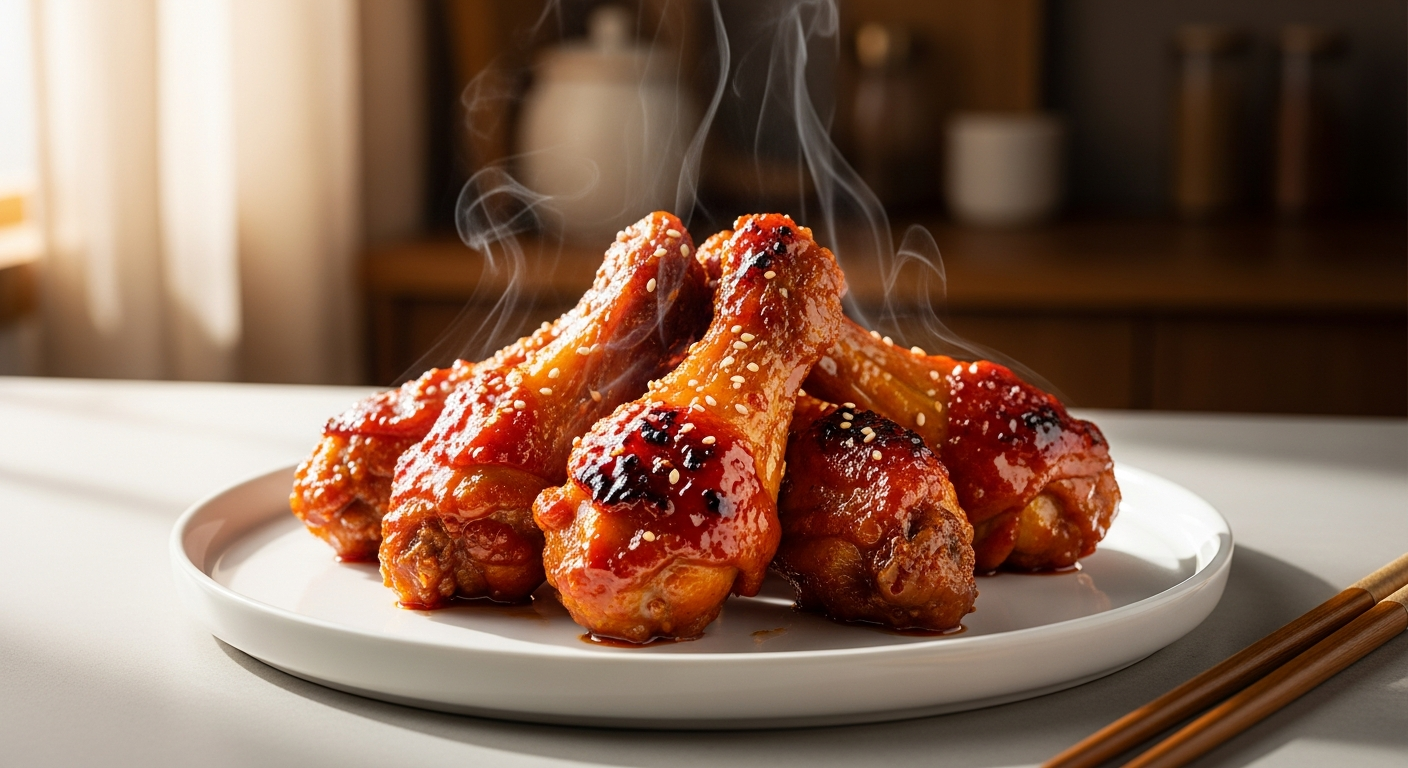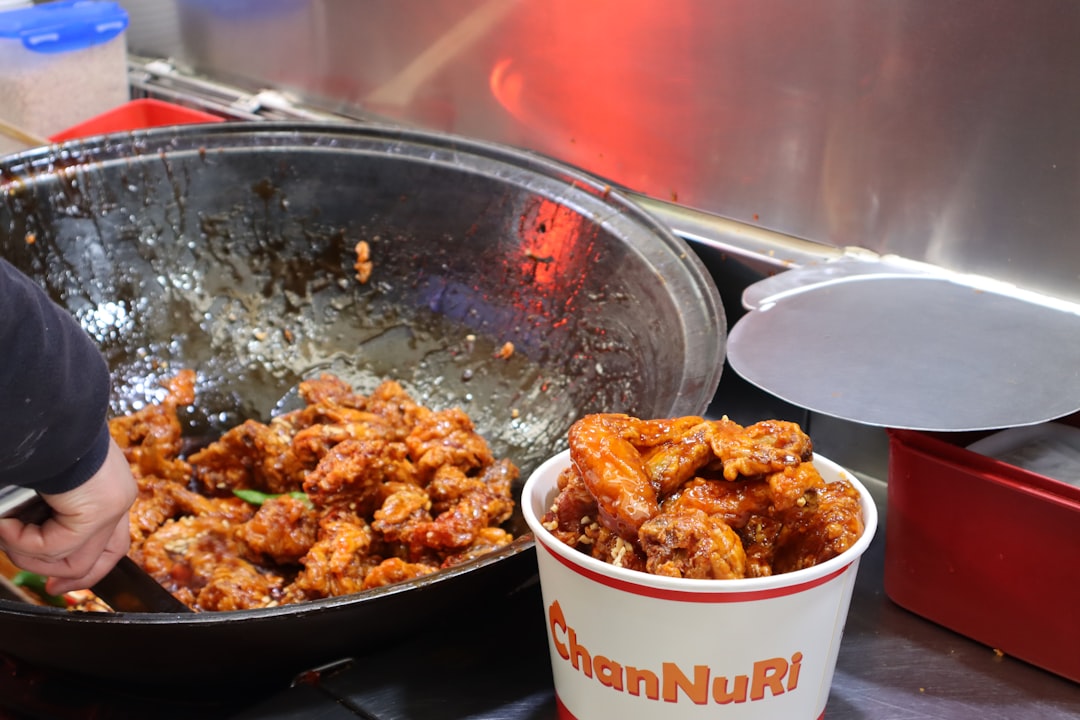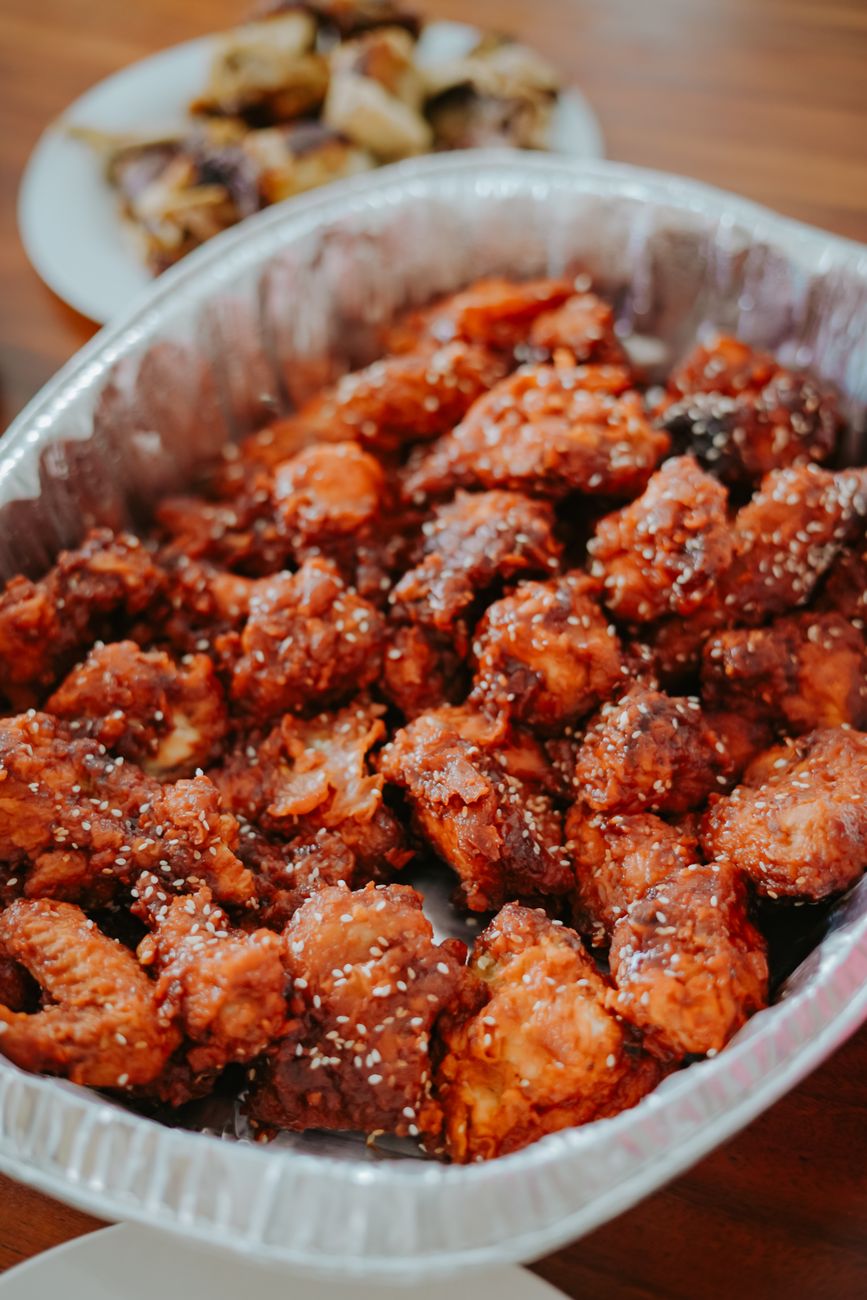
The first time I tried to make Korean fried chicken in my Bayside kitchen, it was a Tuesday, I hadn't made a market run, and I had zero interest in standing over a pot of hot oil with a 4-year-old orbiting my legs.
What I had was a countertop air fryer and a tub of gochujang I'd grabbed, of all places, at Trader Joe's.
That combination rebuilt how I cook Korean food. Less oil, less mess, and it turns out you don't need a special trip to pull most of it off. Here's what I've actually learned. Mistakes included.
Quick answer: Yes, you can make Korean fried chicken in an air fryer. Toss dry chicken in oil, salt, and pepper, dredge it in potato starch or cornstarch, then air fry at 400°F for about 10 minutes per side. Rest 5 minutes, fry a second time for 5 minutes, and toss in gochujang sauce right before serving.
Why the air fryer fits Korean cooking better than you'd think
A lot of Korean fried and glazed dishes are built the same way: cook something until it's crisp or blistered, then coat it in sauce. Fried chicken, tteokbokki, even some banchan (the little side dishes) follow that rhythm. That two-step move is exactly what an air fryer is good at. ( has a few I keep in rotation.)
In Korea, hardly anyone I knew bothered frying chicken at home. You call, and half an hour later a hot bag is at your door — a whole chicken runs somewhere around ₩20,000 to ₩30,000 now, call it $15 to $22, and between price creep and delivery fees the "₩30,000 chicken" people used to joke about is just real life. It was never free. It was just there, always, thirty minutes away. That's the part I miss. Here, delivery is $40 by the time it reaches me, and the closest good place isn't close.
So the air fryer became my compromise. It won't replicate a real deep-fry, and I want to be honest about that. But for a Tuesday, it's close enough that my kids don't notice, and I'm not dealing with a pot of used oil at 9 p.m.
The name thing: yangnyeom, huraideu, dakgangjeong
If you're going to make it, it helps to know what you're making.
Yangnyeom chicken (양념치킨) is the sweet-spicy sauced one — yangnyeom just means seasoned. That's what most people mean when they say "Korean fried chicken." Huraideu (후라이드) is the plain fried version, no sauce. Dakgangjeong (닭강정) is the bite-size, boneless, extra-sticky one.
So if you're air frying boneless thigh chunks, you're really closer to dakgangjeong. Worth knowing if you're serving someone who showed up expecting bar-style drumsticks.
One myth I'd like to put down while I'm here: Korean fried chicken is not "just spicy." Classic yangnyeom is sweet, then spicy, then sticky, roughly in that order. My daughter eats it happily. My youngest eats it with a napkin situation, but he eats it.
Starch, not flour — this is the whole crust
My first few batches were sad and I blamed the air fryer. It wasn't the air fryer. It was the flour.
Korean fried chicken coatings are starch-forward. Some recipes go all potato starch or all cornstarch; plenty cut wheat flour with starch about 1:1, plus baking powder and a little water. Either way, the starch is doing the work — that's what gives you the light, craggy, glassy crust. What you don't want is a thick all-wheat-flour buttermilk-style batter. That's the soft breaded coating, and it's a different dish entirely.
Potato starch (H Mart, big bag, cheap) gets you slightly closer. Cornstarch from any regular grocery store works fine and is what I use most weeks.
Here's the coating, start to finish:
- Dry the chicken. Pat it hard with paper towels. If I have an hour, I leave it uncovered on a rack in the fridge. Wet chicken is the number one reason yours isn't crispy.
- Toss in a little oil, plus salt and pepper. About 1 tablespoon oil per pound.
- Dredge in starch. About 1/2 cup per pound, in a big bowl, tossing until every piece looks chalky-dry with no wet patches.
- Add 1/2 teaspoon baking powder to the starch. Optional. It gives the crust more crackle.
- Shake off the excess and lay pieces in the basket in a single layer, not touching.
That last one matters more than any temperature setting. A crowded basket steams. I do two batches and I've stopped resenting it.
Air fryer times and temps that actually work
Models vary more than ovens do, so treat these as a starting point.
The double-fry is not optional. Fry, rest, fry again. It isn't tradition for tradition's sake — the rest lets moisture come to the surface, and the second fry drives it off. Skip it and you get a crust that's crisp for four minutes and then quits under the sauce.
| Cut | First fry | Rest | Second fry |
|---|---|---|---|
| Bone-in drumsticks/thighs | 400°F, 10 min per side | 5 min | 5 min at 400°F |
| Wings | 400°F, 8 min, flip, 7 min | 5 min | 4-5 min at 400°F |
| Boneless thigh chunks | 400°F, 8 min, shake, 6 min | 5 min | 3-4 min at 400°F |
| Chicken breast | 375°F, 15-18 min, flip halfway | — | — |
Boneless thighs run about 8 to 10 minutes shorter than bone-in. That's the gap nobody tells you, and it's why the same recipe hands you dry chunks or raw drumsticks depending on what you bought.
Breast I mostly skip. It dries out before the crust catches up, and no amount of sauce saves it.
None of this replaces checking. I keep an instant-read thermometer in the drawer specifically for this, because the timer lies. It can't know your air fryer, your piece size, or how cold the chicken was going in. Poultry needs 165°F internal, per USDA guidance. That's the number that matters.
The sauce base that works for almost everything
Once I got this ratio down, it covered yangnyeom chicken, dakgangjeong, tteokbokki — basically any Korean glaze I wanted at home.
- 3 tablespoons gochujang
- 2 tablespoons honey or packed brown sugar
- 1 tablespoon soy sauce
- 1 tablespoon rice vinegar
- 1 teaspoon sesame oil
- 1-2 cloves garlic, minced
- 1 tablespoon ketchup (optional)
Warm it in a small pan for a minute or two, until it loosens and smells like garlic instead of raw paste. The ketchup is not something my mom would have done, but a lot of modern home versions in Korea use it now and it rounds the sauce out. Grated ginger is good here too.
Toss the chicken in sauce right before it hits the table. Never before. Sauced chicken sitting on a plate for ten minutes is just soggy chicken with good flavor. I sauce it in a bowl while everyone's already sitting down.
Adjust the honey up if kids are eating. Mine like it sweeter than I do. Thinned with a splash of water, this same base becomes a dipping sauce, which is how I serve it when my youngest is having a no-red-sauce week.
Where to actually find gochujang in a regular US store
This is the part I wish someone had told me six years ago: you don't need an Asian market.
Gochujang is stocked at Whole Foods, Trader Joe's, Target, Walmart, and most large supermarkets. Check the international or Asian aisle, usually near the soy sauce and rice vinegar. If your store's shelf is thin, Walmart.com and Amazon both ship it. ( covers what else is worth stocking while you're at it.)
One note on Trader Joe's, since that's where I started: their own-brand Gochujang Paste comes in a small tub, around 7 ounces, for about two bucks. They also sell a Gochujang Sauce in a bottle, which is a different product — thinner, already seasoned. For this recipe you want the paste.
If it's genuinely unavailable where you are, the closest single-ingredient swap is sriracha at about 1/3 the amount — much thinner and sharper, so you're compensating, not matching. A better DIY blend is chili garlic sauce plus a spoon of white miso and a touch of sugar, which at least gets you the fermented savory backbone. Both change the flavor and how the sauce clings. They aren't equivalent, and honestly I'd rather wait two days for shipping.
Gochujang vs. gochugaru
These get mixed up constantly and I understand why. Both red, both Korean, usually shelved together.
Gochujang (고추장) is a thick fermented chile paste on a soybean base: sweet, savory, deep. Gochugaru (고춧가루) is dried, coarsely ground red pepper flakes — a spice, not a condiment. Not interchangeable.
Gochugaru is the harder one to find at a regular supermarket, and Italian crushed red pepper is not a swap. Different pepper, different heat, no smoky sweetness. That one's still an H Mart trip for me. ( if you're stuck without it.)
Why yours isn't crispy — the three usual culprits
Every time a batch of mine came out sad, it was one of these:
- Wet chicken. Pat it dry. Then dry it more.
- Crowded basket. Pieces touching means steam. Two batches, always.
- Not enough starch, or you skipped the second fry. Every piece should look chalky before it goes in.
Make-ahead, storage, and reheating
I do the first fry in the morning while the kids are at school, let the chicken cool completely, and refrigerate it uncoated for up to 2 days. At dinner, second fry straight from cold: 400°F, 6-7 minutes. Sauce, serve. It's honestly better than doing it all at once, and it turns a 30-minute dinner into a 10-minute one.
Freezer: freeze first-fried chicken on a sheet pan, then bag it. From frozen, 400°F for about 12 minutes, no thawing. Thawing makes it wet, and wet is the enemy.
Reheating leftover sauced chicken: air fryer at 375°F for 4-5 minutes. Never the microwave — the glaze turns to glue and the crust gives up entirely. It won't be day-one crisp. It'll still be good.
Tteokbokki with the same sauce
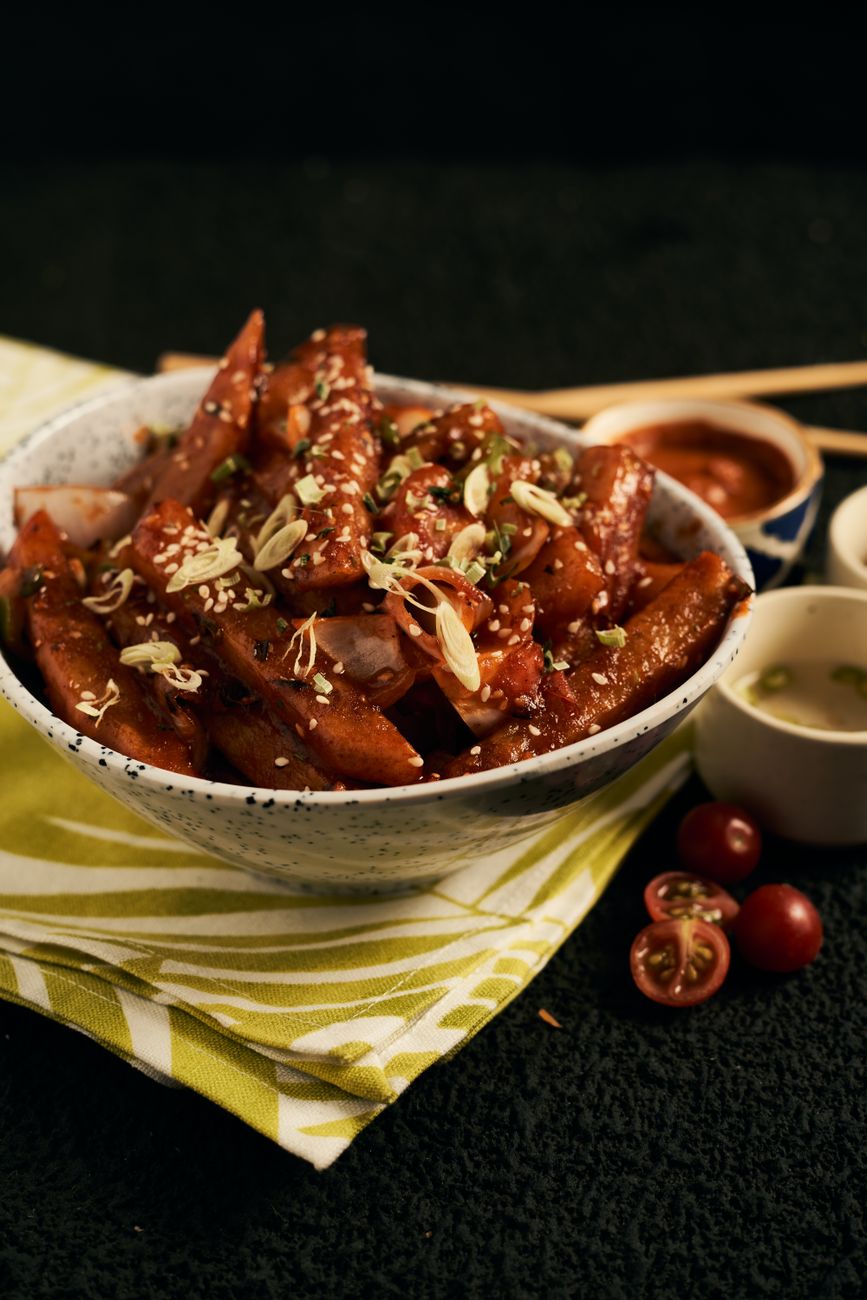
Since you'll have sauce left over: tteokbokki (떡볶이) is spicy stir-fried rice cakes, sometimes spelled ddeokbokki or sold as topokki. Trader Joe's frozen Korean rice cakes work. ( has the full stovetop method if you want to go deeper than this shortcut.)
Soak them in warm water for 10 minutes first. Skip it and they're chewy in the wrong way — I learned that the hard way, twice. Toss lightly in oil, air fry at 380°F for 8 minutes shaking halfway, then toss in warm sauce and give them 2-3 more minutes so the glaze tightens instead of sitting wet on top.
Not the street-cart version simmered in broth. The version I actually make on a Tuesday.
One cultural note
In Korea, fried chicken and beer together is chimaek (치킨+맥주 — chicken plus maekju). It's a whole social thing: friends, a folding table, a summer night. My version is a folding table's worth of paper towels and two kids negotiating over drumsticks. Different. Not worse.
Frequently asked questions
Can you get Korean fried chicken crispy in an air fryer?
Yes, if you do three things: dry the chicken thoroughly, use a starch-forward coating instead of a thick flour batter, and fry it twice with a 5-minute rest in between. Skipping the double fry is the most common reason air fryer versions go soft under the sauce.
Do you need cornstarch or flour for Korean fried chicken?
Starch does the work. All potato starch, all cornstarch, or flour cut about 1:1 with starch — any of those give you the light, craggy crust. What doesn't work is a thick all-wheat-flour buttermilk-style batter, which produces a soft breaded coating that isn't the same dish.
What can I substitute for gochujang?
Look harder first. Trader Joe's, Target, Walmart, and Whole Foods all carry it in the international aisle. If you truly can't get it, sriracha at about 1/3 the amount is the closest single ingredient, or blend chili garlic sauce with a little white miso and sugar. Neither is a real match; the sauce will be thinner and less savory.
How do you reheat Korean fried chicken and keep it crispy?
Air fryer, 375°F, 4-5 minutes. Not the microwave — it turns the glaze sticky and the crust soft. If you planned ahead, store the chicken unsauced and toss it in warm sauce after reheating.
What temperature should chicken reach in an air fryer?
165°F internal, per USDA guidance, no matter which timing you use. Use an instant-read thermometer instead of trusting the timer, since air fryers vary a lot between models.
If you're building out a Korean pantry beyond this one dish, my post on how to store kimchi so it doesn't spoil breaks down the fridge setup that keeps everything from gochujang to banchan actually lasting.