The first time I made Korean fried chicken in my own kitchen here in Bayside, I didn't own a deep fryer, and I didn't want one. Not with a 4-year-old who treats the kitchen like a racetrack and a pot of 350°F oil sitting on a two-burner stretch of stove. What changed everything was realizing my countertop air fryer could get most of the way there. And that I wasn't going to have to hunt down some special import to do it. The gochujang had been sitting in the international aisle at my regular grocery store the whole time.
So here's what actually works, mistakes included.
Quick answer: Air fry starch-coated bone-in chicken at 400°F for about 15 minutes, flip and spritz with oil, then 5 to 7 minutes more — and confirm 165°F internally with a thermometer, because color lies. Rest it 5 minutes, then run it 3 to 5 minutes at 400°F for the crisp-up round. Toss in yangnyeom sauce right before serving, never earlier.
First: Which Chicken Are You Actually Making?
This tripped me up for years, so let me save you the confusion. There are two Korean fried chickens and they're not the same dish.
Huraideu (Original Fried Chicken)
Huraideu (후라이드, from "fried") is the plain one. Just crust, salt, pepper. Thin, dry, loud when you bite it. This is the one that showed up with the beer order back home.
Yangnyeom (Spicy-Sweet Glazed Chicken)
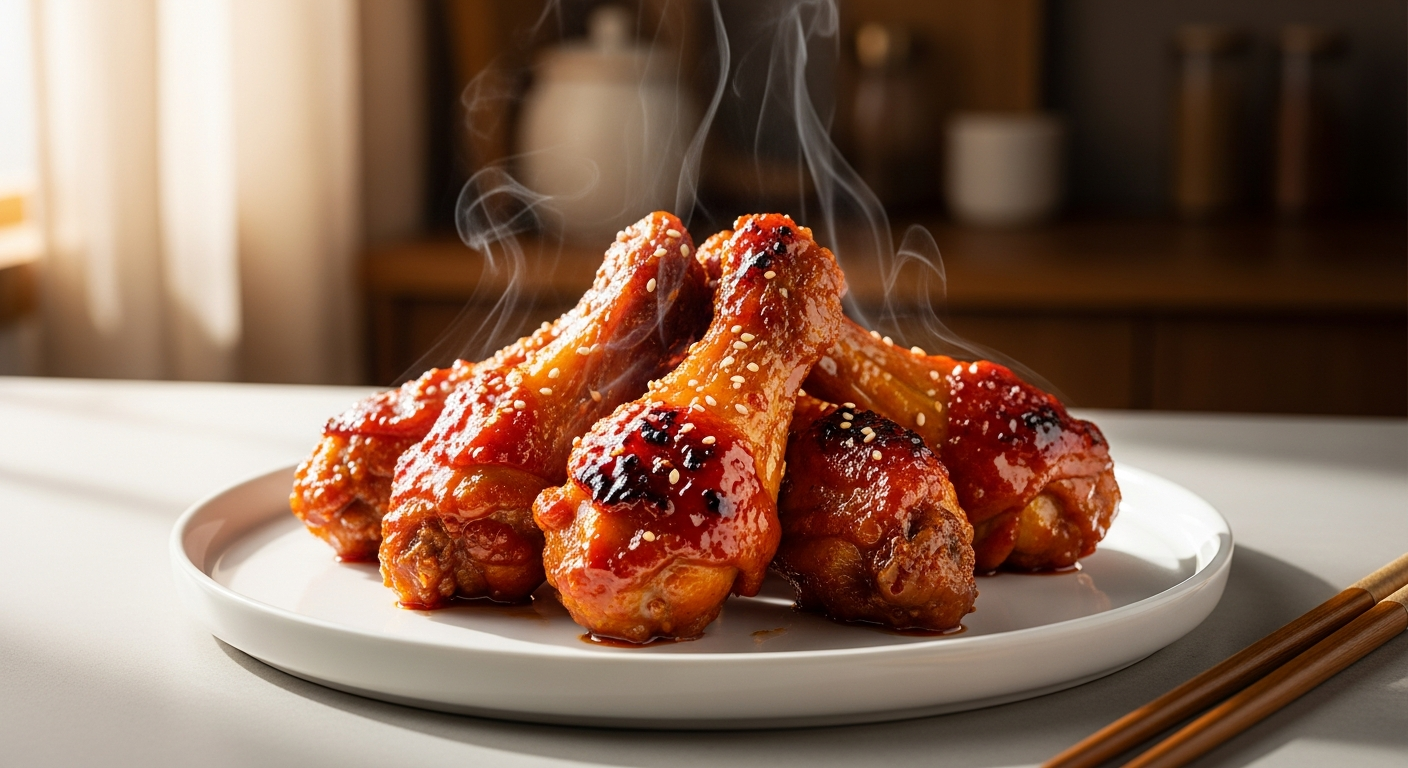
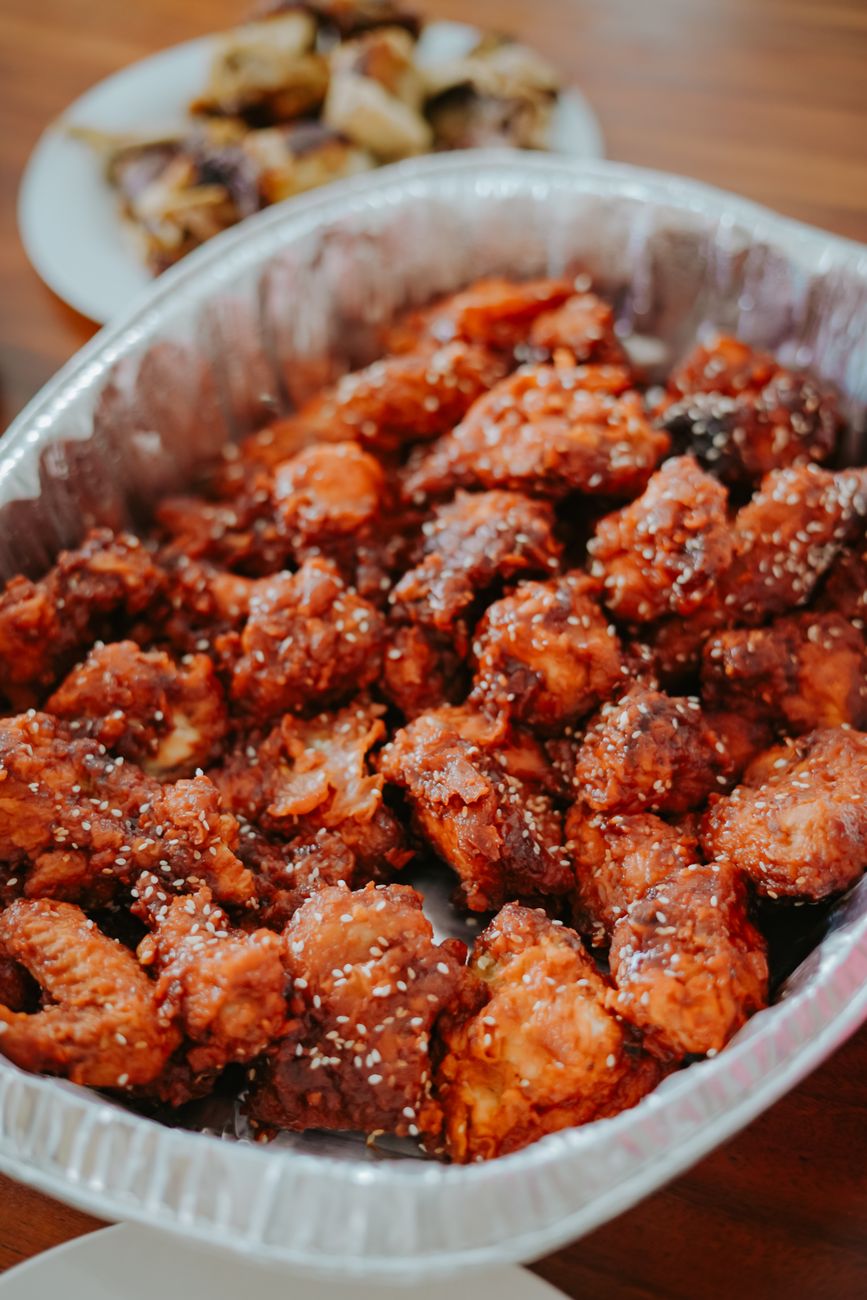
Yangnyeom (양념치킨) is the sweet-spicy red one — the same fried chicken tossed in a gochujang glaze. Pelicana, a chain that started back in 1982, is the one usually credited with popularizing it nationally. If you've had Bonchon or Kyochon or BBQ Chicken here in the States, you know the flavor already.
You fry them identically. The only difference is what happens in the last 30 seconds. Make the plain one first if you've never done this. It's easier to judge whether your crust worked when there's no sauce hiding it.
The Starch Thing (This Is Why It's Not American Fried Chicken)
Korean fried chicken uses potato or corn starch, not a wheat-flour dredge. That's the whole structural difference. Flour builds a thick, bready, craggy crust. Starch builds a thin glassy shell that shatters.
I use potato starch. H Mart has it for a couple of dollars, but plenty of regular Walmarts and Krogers stock it too, and it's on Amazon. This is not a special-order ingredient anymore. Korean pantry staples for grocery store shopping Cornstarch from the baking aisle works fine and is what I reach for when I forget to restock. A 50/50 starch-and-flour blend is also legitimate; it gives a slightly sturdier crust that holds sauce a bit better, which is what I do when I'm making yangnyeom for a crowd.
My method is dead simple: pat the chicken bone dry, salt it, then toss it in a bowl with starch until every piece looks chalky. Shake off the excess. Chalky-dry is correct — if it looks damp or pasty anywhere, that spot will not crisp. That's the single most common reason home air fryer KFC comes out blotchy.
Prep Your Wings Properly (Nobody Tells You This Part)
Air fryers are unforgiving about prep in a way a deep fryer isn't. Oil surrounds everything equally. Hot air doesn't.
- Separate the drumettes and flats. Whole wings have a joint that traps moisture and blocks airflow. Two minutes with kitchen shears fixes this.
- Pat them dry, then dry them more. I lay them on paper towels and press. If I have an hour, I leave them uncovered on a rack in the fridge. This is the trick that finally fixed my skin, and it costs nothing but time.
- Match your sizes. Toss the two giant drumettes into a separate batch. Mixed sizes means the small ones are jerky by the time the big ones hit 165°F.
- Salt before the starch, not after. Salt on top of starch just falls off in the basket.
Boneless thigh works beautifully too, and my kids prefer it. Korean table manners for kids Cut into 1.5-inch pieces, same starch treatment, and knock about 5 minutes off the first stage. Thighs, not breast. Breast in an air fryer at 400°F turns into a regret.
How Long to Air Fry Korean Fried Chicken (Temperature and Timing)
Preheat to 400°F. Yes, actually preheat — 3 minutes. Cold-starting the basket is another reason people get pale results.
Here's my sequence for bone-in wings:
- Spritz the coated chicken with oil before it goes in. Not a drizzle. A light, even mist so no chalky white patches are left. Skip this and the starch stays powdery and raw-tasting. I'll come back to this.
- Cook 15 minutes at 400°F, single layer, no touching.
- Flip, spritz again, cook 5 to 7 minutes. Check for 165°F internal now.
- Rest 5 minutes on a rack (not a plate — a plate steams the bottom).
- Final crisp: 3 to 5 minutes at 400°F. This is the round that changes everything.
You'll see other numbers out there. Ten minutes per side with one flip, or 380°F for 20 total. They can all be right. What doesn't budge is 165°F inside. I keep a $12 instant-read thermometer in the drawer just for this, because "golden and crispy" told me nothing reliable, and I found that out standing over a piece that looked perfect and wasn't.
The Big Lie: "Air Fryers Need No Oil"
I believed this when I bought mine. It's why my first three batches were pale, powdery disappointments.
An air fryer moves hot air. It does not replace the fat that makes starch turn golden and crisp. Without a little oil, the starch just sits there, dry and chalky, and browns unevenly at best.
You need a light oil spray or toss — every stage. We're talking maybe a tablespoon total for a batch of wings, versus a quart in a pot. That's still a massive change. But zero oil gives you zero crunch, and no recipe that claims otherwise has actually tested it.
I use a refillable pump mister with neutral oil. Not the aerosol cans. It's the additives in them, lecithin especially, that do the damage: it has a low smoke point, polymerizes into a sticky film, and degrades the nonstick coating over time. Mine got sticky and weird before I figured that out.
The Two-Stage Cook (The Air Fryer Version of the Double Fry)
In Korea, the good chicken shops fry twice. Once low to cook it through, rest it, then once hot to crisp the shell. That's why the crust survives the sauce instead of going soggy in ninety seconds. I used to think it was restaurant theater. It's not.
The air fryer version isn't re-dipping in batter. It's cook → rest → blast. The rest matters most: steam trapped under the crust escapes while it sits, so the second round crisps a dry surface instead of fighting moisture.
Fry once and you'll get a fine weeknight dinner. Do the second round and someone asks what you did differently. I do it even when dinner's late and I'm tempted to bail, because the version without it goes sad on the plate in about ten minutes and my kids notice.
Yangnyeom Sauce, and When to Add It
The base is gochujang, ketchup, honey (or corn syrup, which is what my mom used), soy sauce, and a lot of garlic. Ginger and sesame oil if you have them. There's no fixed ratio. Every Korean household runs it differently, sweeter or hotter, and mine runs mild because of my youngest. I mix roughly 2 parts gochujang, 2 parts ketchup, 2 parts honey, 1 part soy sauce, then adjust by tasting.
Simmer it 2 to 3 minutes in a small pan on low until it's glossy and just coats a spoon. Low heat. The sugar scorches faster than you'd think, and burnt gochujang is bitter in a way nothing rescues.
Toss the chicken in sauce in a big bowl right before it goes to the table. Not in the air fryer. Not five minutes early. Sauced chicken sitting on the counter is just soggy chicken with a countdown. If people are eating at different times, which is every night here with my husband getting home late, I keep the sauce warm and toss single portions as they sit down.
No Gochujang at All?
You can get close with sriracha plus a spoonful of brown sugar and a little soy sauce. It's a different animal, sharper and without the fermented depth, but it's real food. Or make soy garlic instead: soy sauce, honey, garlic, rice vinegar, a splash of water, simmered down. That's the other chain-shop classic and honestly the one my kids ask for.
Your Air Fryer Isn't My Air Fryer
Nobody says this and it causes half the failures.
Basket-Style Air Fryers
Mine, a small 4-quart — strong airflow from directly above, small chamber, cooks fast and aggressive. Times in this post are for this.
Oven-Style / Toaster Oven Air Fryers
Bigger chamber, gentler air circulation, often need 3 to 5 more minutes and a rack rotation partway. The top rack runs hot; the bottom lags.
Two basket models of the same size can run noticeably different, too. Someone else's times could leave my chicken bone-dry. Treat my numbers as a starting point and calibrate on your first batch. Write your actual time on a sticky note inside a cabinet door. Mine's still there.
Batch Cooking Without Ruining It
The single-layer rule is not negotiable. Overlapping pieces steam each other and you get pale gummy patches where they touched. Every time.
My 4-quart basket fits about 8 to 10 wing pieces in a real single layer. That's dinner for maybe two people. For a bigger batch:
- Run stage one on everything in batches, in advance. Hold the cooked pieces on a wire rack at room temp, up to an hour.
- Then do the final 3 to 5 minute crisp round all together right before serving. You can crowd this round slightly. It's short and the crust is already set.
- Add a minute to batch two and beyond. The basket is already hot, but so is the residual moisture, and things drift.
This is the workaround for a small kitchen, and it's how I do Saturday nights.
Troubleshooting: Why Yours Came Out Wrong
I've made every one of these mistakes in my own kitchen.
| What went wrong | Why | Fix |
|---|---|---|
| Soggy or pale coating | No oil spray, or the chicken was wet before starching | Pat bone dry, spritz every stage until no white patches show |
| Crispy outside, raw inside | Pieces too big, or basket overcrowded | Smaller/uniform pieces, single layer, thermometer to 165°F |
| Crust falls off | Too much starch, or wet spots underneath | Shake off excess hard; the coating should be thin and chalky, not caked |
| Burnt, bitter sauce | Sauce cooked in the air fryer, or simmered too hot | Never sauce in the basket. Low heat, 2 to 3 minutes, off the heat when glossy |
| Crisp for 5 minutes, then soft | Sauced too early, or rested on a plate | Rack, not plate. Sauce at the table |
| Chalky white patches | Not enough oil, straight up | More mist. This is almost always it |
If you only fix one thing: it's the oil spray. That's 80% of every failed batch I've had.
Frozen Wings, and Rescuing Leftovers
Life with kids means I don't always plan far enough ahead to thaw. Frozen works, with a change in order.
Air fry the frozen wings naked at 380°F for 10 minutes first, just to thaw and drive off surface ice. Pull them out, pat dry — there will be water, a lot of it — then starch, spritz, and run the normal sequence. Starching frozen wings straight from the bag gives you paste, not crust. I know because I did it.
For leftovers, if any survive, which is genuinely not a given here: 400°F for 5 to 7 minutes brings the skin back to something close. Already sauced? Same thing, just watch it; the sugar can catch. A microwave will never do this. It steams the crunch right out and you end up with a wet napkin that used to be dinner.
Unsauced leftovers keep 3 days in the fridge. Sauced ones are best the next day and honestly fine cold, standing at the counter, which is how I eat most of mine. how to store kimchi in the fridge
FAQ
Why isn't my air fryer Korean chicken crispy?
Almost always not enough oil. Air fryers need a light spray for starch to brown and crisp — "zero oil" is marketing, not cooking. After that, check for crowding and whether your chicken was fully dry before you coated it. Wet chicken plus starch makes paste, and paste never crisps.
What temperature and time work best for air fryer Korean fried chicken?
400°F, about 15 minutes, flip and spritz, 5 to 7 more — then rest 5 minutes and give it a final 3 to 5 minute blast at 400°F. Oven-style air fryers usually need 3 to 5 minutes extra. Pull at 165°F internal regardless of what the timer says.
Can you use frozen wings in the air fryer for this?
Yes, but cook them plain at 380°F for 10 minutes first, pat off the water, and then coat in starch. Coating frozen wings directly gives you a gummy mess. Add the usual time back on after that and check internal temperature closely, since frozen pieces cook unevenly.
What's the difference between yangnyeom and soy garlic Korean chicken?
Yangnyeom is the sweet-spicy red one: gochujang, ketchup, honey, garlic. Soy garlic is savory and mild: soy sauce, honey, garlic, a little vinegar, no chili paste. Same fried chicken underneath; only the glaze changes. Soy garlic is the kid-friendly pick.
Can I make Korean fried chicken without gochujang?
Yes. Sriracha with brown sugar and soy sauce gets you a decent sweet-heat glaze, though you lose the fermented depth. Or skip the chili entirely and make soy garlic. That said, gochujang isn't hard to find anymore. CJ Haechandle (500g and 1kg tubs) is stocked at Walmart and Amazon, and Chung Jung One's Sunchang line turns up at Walmart and Kroger. H Mart has both.
If you're stocking up on gochujang for this, don't stop at one recipe — the full lineup of air fryer Korean recipes using regular grocery store ingredients covers what else that same tub of paste can do.